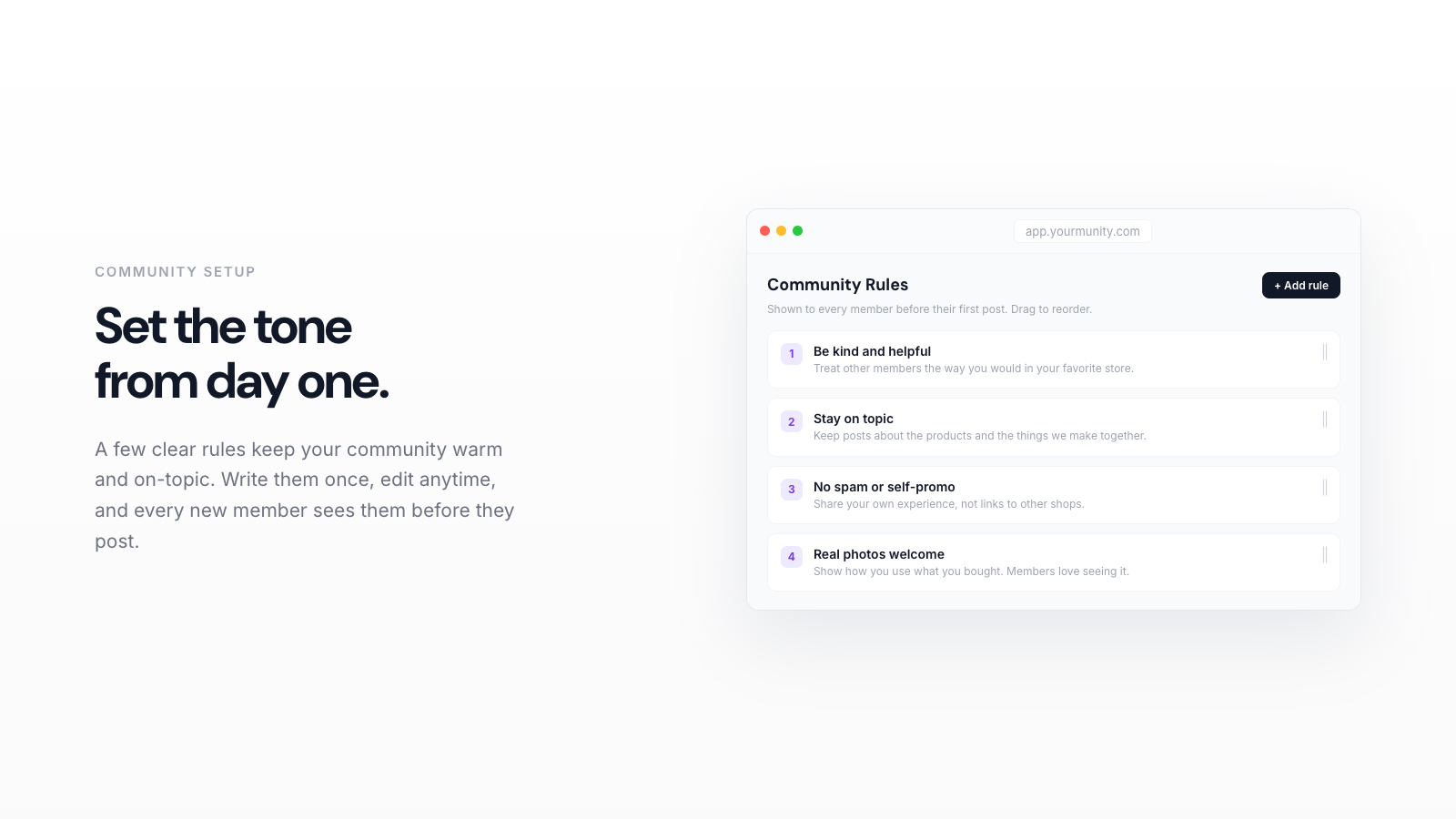
Good community rules are less about policing behavior and more about telling people what your space is for. Write them warm, short, and specific, lead with what you want people to do, and post them where new members actually see them. This guide walks you through a simple template with real community guidelines examples you can copy.
When you open a community for your Shopify store, the rules are the first thing that tells people what kind of place they just walked into. Get them right and members relax, post more, and treat each other well. Get them wrong (or skip them) and the loudest voice sets the tone for everyone. This is a practical walkthrough for writing guidelines that feel like a welcome mat, not a warning sign.
1. Start With What the Space Is For
Before you write a single rule, finish this sentence: This community exists so that ___. Everything else follows from the answer. A skincare brand might say "so customers can share routines and get honest advice." A coffee roaster might say "so people can talk brewing, swap ratios, and show off their setups."
That one line does more work than a wall of restrictions. It tells a new member whether they belong here and what they should post. When someone knows the purpose, they self-police better than any rule could force them to. So put your purpose at the very top of your guidelines, in plain language, before you get anywhere near the word "prohibited."
2. Lead With Do, Not Don't
Most community guidelines read like a list of ways to get banned. Flip it. People mirror the energy you set, so open with the behavior you want more of. Compare these two:

- Don't: "No self-promotion, no spam, no off-topic posts, no rudeness."
- Do: "Share what you're working on, ask real questions, and cheer on other members. Show us your setup, your wins, and your works in progress."
Both technically cover the same ground, but the second one makes someone want to post. Aim for a rough 3-to-1 ratio: three encouraging lines for every restriction. You will still spell out the limits, but the first impression should feel like an invitation.
3. Keep It Short and Human
Nobody reads a 2,000-word terms-of-service scroll before their first post. If your rules can't fit on one screen, they will not get read. Aim for five to eight short rules, each one sentence, written the way you would actually talk to a customer.
Skip the legalese. "Be kind, even when you disagree" beats "Members shall refrain from engaging in conduct deemed harassing or inflammatory." One sounds like a person who cares about the room; the other sounds like a liability waiver. Your community is an extension of your brand voice, so let the rules sound like you.
4. A Template You Can Copy
Here is a full set of community guidelines examples you can adapt in ten minutes. Swap the specifics for your brand and product:
- This is a place for [purpose]. Post your questions, wins, and works in progress. Real talk welcome.
- Be kind, especially when you disagree. Critique the idea, not the person. Assume good intent.
- Keep it useful. Share what actually helped you. Vague hype and one-word posts don't add much.
- Show, don't just tell. Photos, before-and-afters, and honest reviews make this place worth visiting.
- No spam or drive-by selling. If it's your own product or link, ask us first. Members can smell a pitch.
- Respect privacy. Don't share anyone's personal info, including your own order details in public posts.
- When in doubt, ask. We're here and we read everything.
Notice how the restrictions (rules 5 and 6) sit in the middle, wrapped in positive framing. That placement matters. Members read the top and bottom most, so bookend your guidelines with warmth.
5. Tie Rules to How People Actually Post
Rules work better when they match the structure of your space. If every post carries an intent tag like Show & Tell, Review, Idea, or Question, your guidelines can reference those directly: "Posting a review? Be specific about what you tried and what happened." This is exactly how a Yourmunity feed is set up, so your rules can point to the tag someone is already choosing instead of describing behavior in the abstract.
The same goes for onboarding. When members complete a short identity step before they post, the first thing they see can be your guidelines. That is the highest-attention moment you will ever get, far better than burying rules in a pinned post nobody scrolls back to. Put your purpose line right there.
Yourmunity is free right now. Add your community to your Shopify store in minutes and start turning buyers into regulars.
Add to Shopify →6. Decide Enforcement Before You Need It
The moment a rule gets broken is the worst time to figure out your policy. Decide in advance, in one or two sentences, what happens when someone crosses a line. A simple, fair ladder works for most brands:
- First slip: a friendly public or private nudge. Most people just didn't read the rules.
- Repeat or clearly bad-faith: remove the post and send a direct note explaining why.
- Spam, harassment, or scams: remove and ban, no warning needed.
Being consistent matters more than being strict. If you let one long-time customer break a rule that you enforce on newcomers, the whole room notices and trust erodes. Write your ladder down, even if only you and one moderator ever see it.
7. Set the Tone by Posting First
Rules describe the culture; your own posts create it. In the first weeks, be the member you want others to be. Ask genuine questions, reply to every post, thank contributors by name, and share works in progress of your own. People copy what they see far more than what they read.
Watch who shows up. A dashboard that surfaces your top contributors tells you who to lean on and eventually invite as a moderator. The best community moderators are almost always regulars who already model the behavior your rules describe, so you are promoting, not policing.
8. Revisit Every Few Months
Your first draft will not be your last, and that is fine. As the community grows, new situations come up that your rules never anticipated. Set a reminder to reread your guidelines every quarter and ask: is anything here confusing, unenforced, or just unnecessary now?
Prune the dead rules. If you have never once needed a guideline, it is clutter that makes the important ones harder to find. A living set of rules that stays short and clear beats a comprehensive one that nobody finishes reading. The goal has never been to cover every case; it is to set a tone so clear that most cases never come up.
The Payoff
Community rules are not paperwork. They are the fastest lever you have for turning a room full of strangers into regulars who feel like they belong. Lead with purpose, write like a human, encourage more than you restrict, and put the rules where new members actually see them. Do that, and your guidelines will spend most of their time being ignored, which is exactly what you want. A healthy community polices itself because everyone already knows what the place is for.