
A community keeps customers coming back because it gives people a reason to return that has nothing to do with needing another product yet: belonging, recognition, and a place where their voice matters. When buyers become members, they check in, post, and buy again on their own schedule instead of waiting for your next discount email.
The retention problem most Shopify stores quietly have
You spend real money to get a customer. Then, for most stores, that customer buys once and vanishes. Your win-back flow fires, a coupon goes out, and maybe one in ten comes back. It works, but it is expensive and it treats every returning purchase as something you have to buy again with a discount.
The stores that grow without burning cash on constant reacquisition have something different going on: their customers have a reason to come back that is not tied to a promo. That reason is usually a sense of belonging. A community is the simplest way to build it, and it changes customer retention from a series of one-off nudges into an ongoing relationship.
Why belonging beats points for repeat customers
Points programs work on math. Spend more, get a reward, redeem it. The trouble is the customer only shows up when the math is in their favor, and the moment a competitor offers better math, they switch. You have trained them to care about the discount, not about you.
A community works on something stickier. People come back to a place where they are known, where they got a helpful answer, where their photo got a bunch of upvotes, where the founder replied to their idea. That is not a transaction, and it does not expire. Belonging is far harder for a competitor to copy than a 10 percent coupon, which is exactly why repeat customers who feel part of a community are worth more over time.
What actually happens when a buyer becomes a member
Think about the difference in behavior. A buyer visits your store when they need something. A member visits your store even when they do not need anything, because there is something to see: new posts, questions to answer, other people showing off what they bought. Every one of those visits is a chance to buy again, and it costs you nothing to earn.
Here is the practical shift you are engineering:
- From notification to habit. Instead of waiting for your email, members check the feed on their own.
- From private to social. A customer who posts a photo of their order is now publicly invested in your brand.
- From silent churn to visible signal. A member who has a problem posts a question instead of quietly leaving. You get a chance to save them.
The four kinds of posts that drive return visits
Not all community activity is equal. The content that actually pulls people back tends to fall into four buckets, and it helps to make each one easy to create:
- Show and Tell. Customers posting what they bought and how they use it. This is your best marketing, made by the people you would most want to convince.
- Reviews. Honest takes that live on your own turf instead of a third-party site, building trust for the next shopper.
- Ideas. Feature and product requests. This is a direct line into what your best customers wish you sold next.
- Questions. The single most valuable post type for retention, because a question is a customer telling you they are about to be happy or about to leave.
This is where a tool like Yourmunity earns its keep. It gives every post an intent tag from exactly these categories, so you are not staring at an undifferentiated wall of chatter. You can see the questions that need answers and the ideas worth acting on at a glance.
How to launch a community that people return to
A quiet community is worse than no community, so the launch matters. Keep it simple and do these things in order:
- Put it where people already are. A community that lives at yourbrand.com/community, right inside your store, gets found. One that requires a separate app download does not.
- Seed the first posts yourself. Before you invite anyone, add a handful of Show and Tell posts and ask two or three real questions. Nobody wants to be the first to talk in an empty room.
- Invite your best 20 customers first. Not everyone at once. Start with the people who already love you, in a post-purchase email or your order confirmation.
- Reply to everything for the first month. Early members need to feel heard. Your replies are the signal that this place is alive and worth returning to.
- Give a light onboarding. A short identity step, who they are and what they are into, makes the space feel personal and gives you useful first-party data at the same time.
Yourmunity is free right now. Add your community to your Shopify store in minutes and start turning buyers into regulars.
Add to Shopify →Measuring whether it is actually working
Community can feel fuzzy, so anchor it to numbers you already care about. The one metric that cuts through everything is this: do members buy more often than non-members? If your community members have a higher repeat purchase rate than customers who never joined, the community is doing its job, full stop.
Watch a small set of signals:
- Member vs non-member purchase rate. The headline. This tells you the community is driving revenue, not just noise.
- Return visits per member. How often people come back to the feed. Habit is the leading indicator of retention.
- Top contributors. Your handful of superfans. These are the people to reward, feature, and listen to hardest.
- Unanswered questions. Your churn-prevention queue. Every one you answer fast is a customer you probably kept.
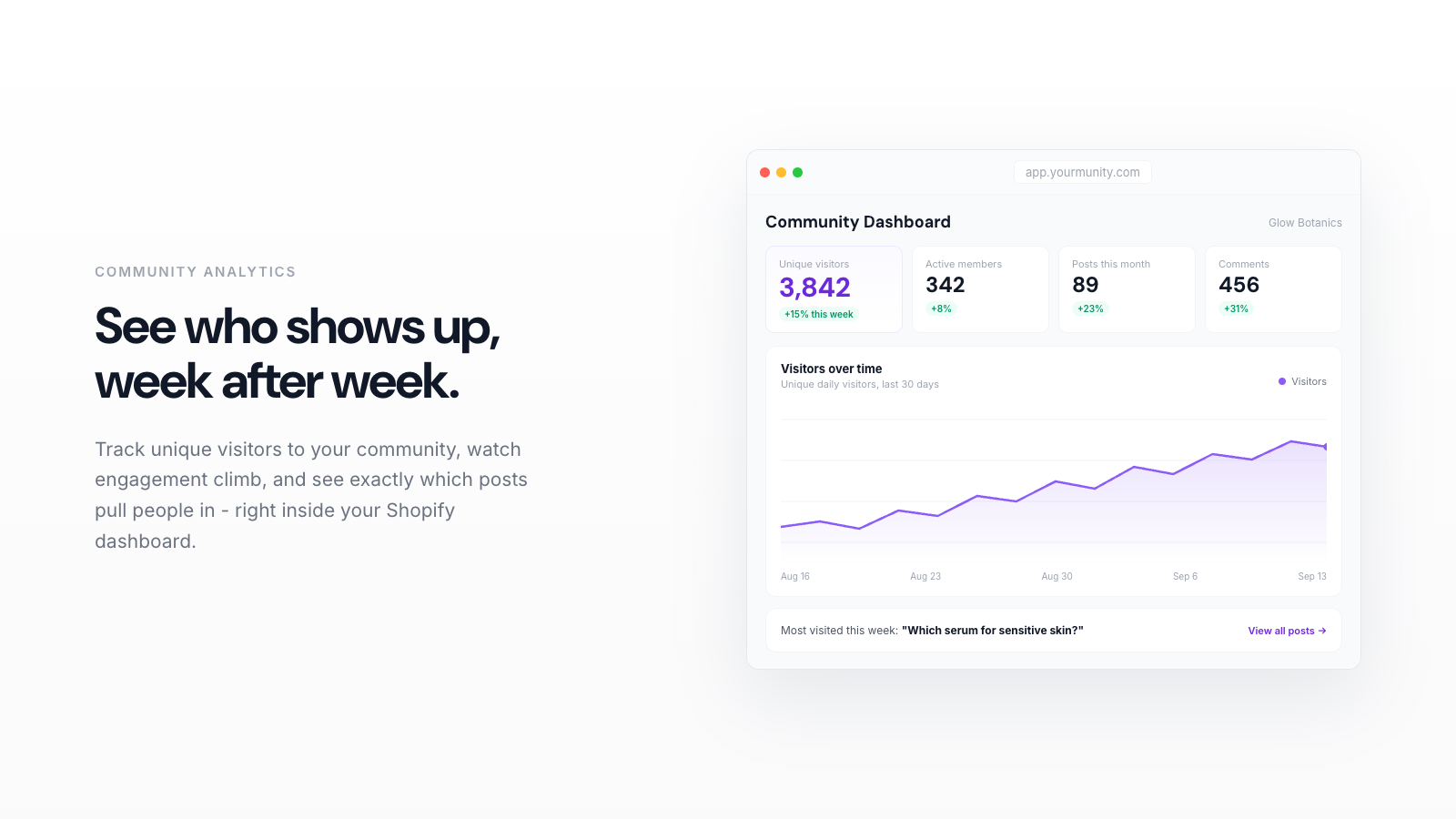
A dashboard that surfaces member versus non-member purchase rate, unique visitors, top contributors, and retention in one place, the way Yourmunity does, means you are not guessing. You can see the community paying for itself.
The data and content you get to keep
There is a bonus that goes beyond retention. Everything your members create, their photos, their reviews, their questions and the answers, is content you own. So is the identity data from onboarding. That is first-party data and user-generated content sitting on your domain, not rented from an ad platform or trapped inside someone else's social network.
In a world where ad costs keep climbing and third-party data keeps shrinking, owning a direct relationship with your customers is not a nice-to-have. It is the moat. A community is the container that holds it.
Start small, stay consistent
You do not need thousands of members to see the effect. A few dozen engaged customers who post, vote, and come back will already lift your repeat rate and hand you a stream of honest feedback. The stores that win are not the ones with the biggest community on day one. They are the ones who showed up every day, answered the questions, and let belonging do the quiet work of bringing people back.