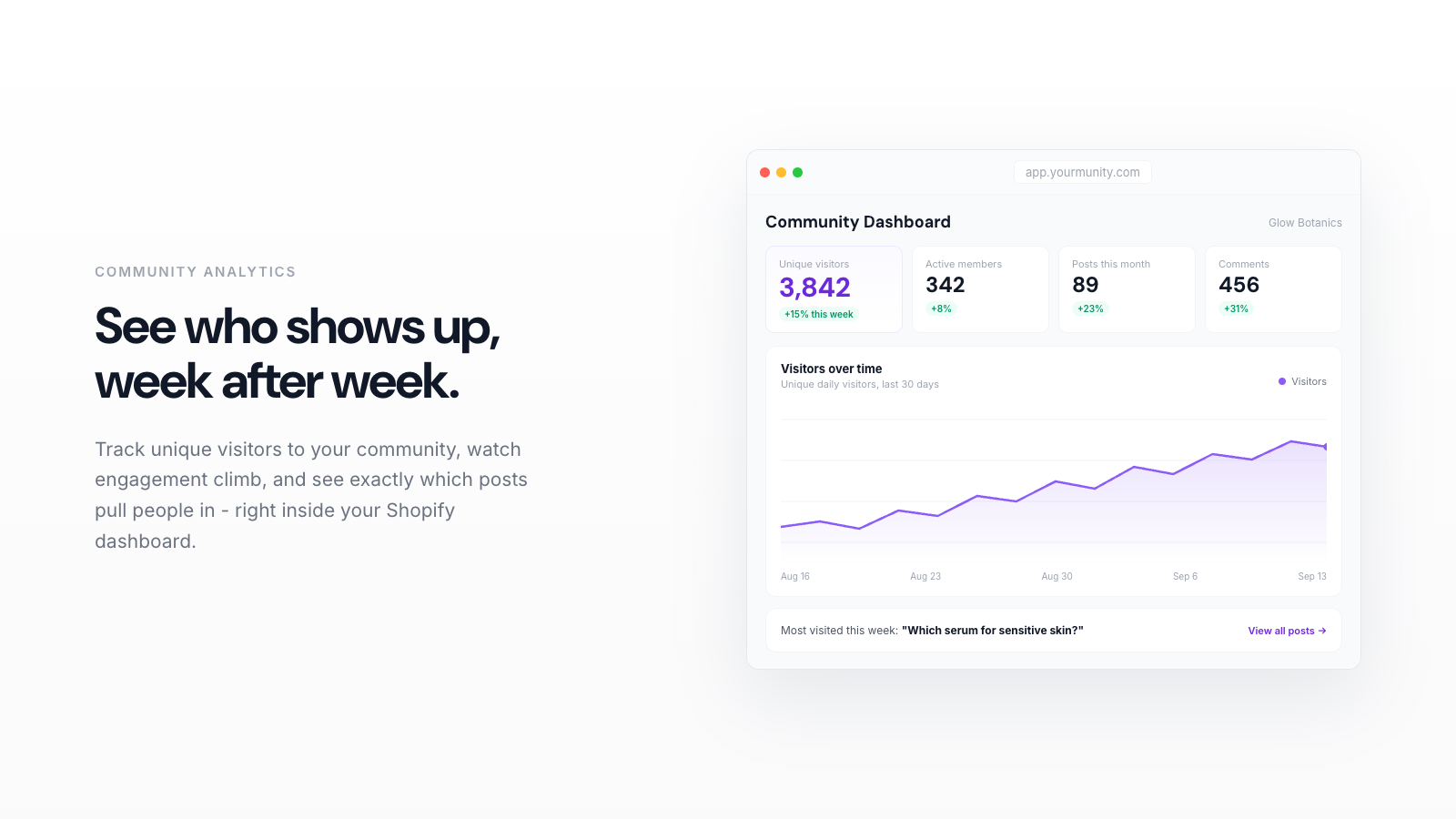
Measuring community success comes down to a handful of metrics that tie belonging to revenue: member versus non-member purchase rate, active contributors, retention, and the UGC your community produces. Track those instead of vanity signups, and you will know within a few weeks whether your community is turning buyers into regulars.
Start with the one number that proves it works
Most store owners open an analytics dashboard, see a signup count going up, and assume things are healthy. Signups are the easiest number to grow and the least useful for decisions. If you only track one thing, track the gap between how often members buy and how often non-members buy.
This is the whole thesis of a community in one metric. If your members purchase at 4.1 percent and your non-members purchase at 1.8 percent, you are not looking at a nice-to-have. You are looking at a group of customers worth roughly twice as much, and every person you move into that group is worth the same lift. Yourmunity surfaces this as a direct member vs non-member purchase rate comparison, so you are not stitching it together from spreadsheets. Watch the spread widen over time. That is success.
Separate vanity metrics from health metrics
Before you build a dashboard, sort your numbers into two buckets so you stop celebrating the wrong ones.

- Vanity metrics feel good and move on their own: total signups, page views, total posts ever created. They go up whether or not anything real is happening.
- Health metrics require actual participation and predict revenue: active contributors, comments per post, repeat visitors, retention week over week, and purchase rate by member status.
A community with 3,000 signups and 12 active contributors is in worse shape than one with 400 signups and 90 active contributors. Judge yourself on the second bucket.
The five community metrics that matter
Here is the short list to actually run your community on. You can find all of these in a proper community analytics setup, and none of them require a data team.
1. Active contributors
Count the unique members who posted, commented, or voted in the last 30 days, not just the ones who logged in. This is your real community size. A useful rule of thumb: aim for at least 5 to 10 percent of members to be active contributors. Below that, you have an audience, not a community.
2. Member vs non-member purchase rate
Covered above, and it is the metric that ties everything to money. Revisit it monthly and note whether the gap is growing.
3. Retention
Of the members who joined a given month, how many are still active 30 and 60 days later? Retention tells you whether people are finding a reason to come back or whether you have a leaky bucket. A rising signup line with flat retention means you are refilling the same empty room.
4. Content per member (UGC output)
How many reviews, photos, and answers are members creating? This is first-party content you own and can reuse on product pages and in email. If ten members post their setups in a month, that is ten pieces of authentic proof you did not have to write.
5. Top contributors
Identify the handful of people driving most of the activity. These are your future moderators, beta testers, and word-of-mouth engine. Knowing who they are is itself a metric of health.
Read intent, not just volume
Raw post counts hide the story. What you want to know is why people are posting. In Yourmunity every post carries an intent tag, so a member is either doing Show and Tell, leaving a Review, sharing an Idea, or asking a Question. That turns a flat feed into a signal.
A spike in Questions might mean your product docs are thin. A wave of Show and Tell means customers are proud enough to show off, which is gold for social proof. A steady stream of Ideas is a free product roadmap. Track the mix, not just the total, and you get a read on customer sentiment you cannot buy from an ads dashboard.
Yourmunity is free right now. Add your community to your Shopify store in minutes and start turning buyers into regulars.
Add to Shopify →Set a baseline before you judge anything
You cannot measure improvement without a starting line. In your first week, write down four numbers: unique visitors, active contributors, member purchase rate, and non-member purchase rate. Do not touch them for 30 days. New communities are quiet at first, and reacting to week-one silence is how good communities get abandoned.
After 30 days, compare. You are looking for direction, not perfection. Are contributors climbing? Is the purchase-rate gap opening up? Are people coming back? Trend beats absolute value every time when you are young.
A simple monthly measurement routine
Turn this into a habit so it takes ten minutes, not an afternoon.
- Open your community dashboard on the first of the month.
- Record the five metrics above next to last month's numbers.
- Note the member vs non-member purchase gap and whether it grew.
- Scan the intent mix for any spike in Questions (a fix) or Ideas (an opportunity).
- Thank your top three contributors by name, publicly. Recognition is the cheapest retention lever you have.
Five minutes of that ritual will teach you more about your customers than a month of scrolling order reports.
What good looks like at each stage
Benchmarks depend on your traffic, but here is a rough map. In the first month, success is simply a nonzero group of repeat contributors and a baseline you trust. By month three, you want retention holding above zero decay and a visible purchase-rate gap. By month six, active contributors should be a stable percentage of members, UGC should be feeding your product pages, and the member purchase rate should clearly beat the non-member rate. If those three things are true, your community is not a project anymore. It is an asset.
Why owning the data changes the game
The last thing worth measuring is what you keep. Every metric above is built on first-party data you own, not rented from a social platform's algorithm. That means the identity signals from onboarding, the UGC, and the behavioral trends stay yours to act on. A community that lives at yourbrand.com/community is a measurement surface no ad network can take away, and that is ultimately what makes the numbers trustworthy enough to run a business on.